
The artist books are available in print and can be purchased—either by mail or in person.
If you are interested or have any questions, please feel free to contact me.
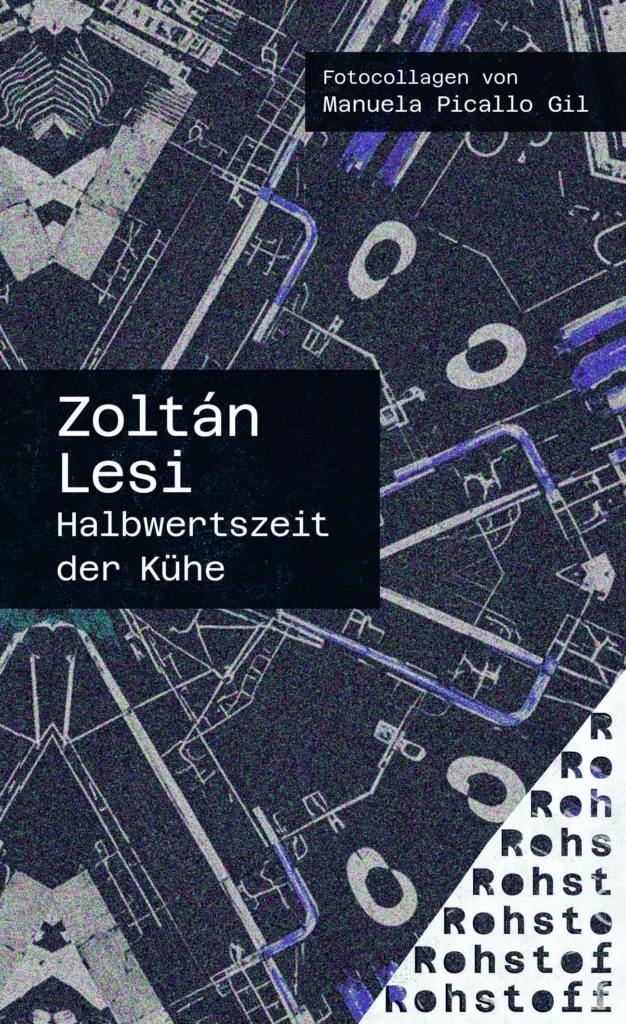
Halbwertszeiten der Kühe (Half-Life of Cows)
“On 26 April 1986, when an explosion occurs near the Ukrainian city of Prypiat, the world seems to split into a before and an after. In an instant, where there had once been vibrant life, there is only land contaminated by radioactivity—the people evacuated, plants and animals contaminated, and an exclusion zone spanning more than thirty kilometres established. But what remains of a place whose futures, like the dust released by the reactor disaster, are scattered to the winds? Whose past has already been poisoned by pogroms, famine and dictatorship? In three long poems, Zoltán Lesi’s Halbwertszeiten der Kühe takes us to Chornobyl, giving voice to animals, liquidators, children and digital avatars. In doing so, it portrays not merely the site of a catastrophe, but a landscape of memories, voices and traces, where fairy tales and prayers, technology and nature, imagination and reality encounter one another.” Zoltán Lesi
Two artistic languages come together in the book Half-Life of Cows: Zoltán Lesi’s long poems and Manuela Picallo Gil’s photographic collages enter into a dialogue in which words and images encounter one another, unfold their own stories and open up new perspectives for each other.
2026, Poetry with Photo Collages
Publisher: Rohstoff @ Matthes & Seitz Berlin
ISBN: 978-3-7518-7034-4
Publication date: 1 October 2026
Language: German
Readings: Dates and venues will be announced soon.

Erinnerungspeicher: EN PARALELO (Memory Storages: EN PARALELO)
Erinnerungspeicher: EN PARALELO invites visitors into a space of reflection while simultaneously presenting an emerging architectural vision. Inspired by traditional storage buildings—the Tschardaken of northern Burgenland and the Hórreos of northern Spain—a new construction takes shape. For generations, these storage structures were used to dry and store corn, grain, and firewood, ensuring survival. Today, they are protected as cultural monuments and form part of the Burgenland and Galician heritage. Particularly in Galicia, they remain integrated into daily life and are often repurposed. Their original function may fade, but as symbols of rural identity and resilient subsistence, they retain their significance. These buildings shaped social and economic structures, defined property and spatial boundaries, and embody the knowledge of multiple generations.
Manuela Picallo Gil’s architectural reinterpretation now stores memories in the form of visual elements and sound fragments, addressing migration, cultural heritage, multiculturalism, and the transformation of rural spaces within the tension between tradition and change. It preserves memories that express themselves visually and acoustically while maintaining a personal connection to the artist—rooted yet in motion between the two regions and between countryside and city.
The publication accompanies the exhibition of the same name, with contributions by Sigrid Irene Wentzel, Marlene Wagner, and Manuela Picallo Gil. Excluding the introduction, the publication contains three contributions: the first is Sigrid Irene Wentzel’s article “More than Stone and Wood: Tschardaken and Hórreos from a Social-Anthropological Perspective”. This is followed by Manuela Picallo Gil’s “LÌNEAS RESONANTES. Border Landscapes and Shared Stories”. The publication concludes with Marlene Wagner’s contribution: “Storage Architectures or How Form Follows the Stories We Inhabit”.
2025, Artist’s Book, 143 × 202 cm, 20 pages, color print.
1st edition: 30 copies
Language: German

Menschen, Ziegel und Unkraut
The artist collective CRAFT, that is Oscar Cueto and Manuela Picallo Gil, is dedicated to a historical period in the history of northern Burgenland: the brickworks “Erste Walbersdorfer Dampfziegelei” and “Hartig & Rothermann”. These former production sites, where millions of bricks were manufactured from the 1870s onwards, are exemplary of the profound change from an agrarian way of life and work to industrial modernity.
The project sheds light not only on the economic development, but also on the social consequences of this transformation. The focus is on the living and working conditions of people who worked under high pressure, often in precarious circumstances, to ensure efficiency and profit – both in Burgenland and in the rest of Austria. At the same time, Menschen, Ziegel und Unkraut examines how the ideals of industrial optimization have changed our understanding of work, meaning and community – and what effects they still have today. How can creative and collective forms of work be (re)imagined today? Can we reshape our relationship with nature beyond utility?
The installation of the same name is now on permanent display in the garden of the 70er Haus der Geschichten in Mattersburg. A publication documenting the historical research and artistic reflections will also be published to coincide with the opening.
2025, Artist’s Book, 143 × 202 cm, 20 pages, color print.
1st edition in German: 100 copies
1st edition in English: 50 copies
Print: Online Druck GmbH, Wr. Neudorf
Publisher: Dr. Georg Luif, 70er Haus der Geschichte, Mattersburg

CULVITA Memento Prunus Mahaleb
The Prunus mahaleb tree connects western Hungary and eastern Austria, where the cultivation centers were once located. The plant came to Lower Austria via Burgenland. It reached Esztergom through Pál Oltósy. There, Oltósy founded the Prunus mahaleb tree industry, which shaped the history of the region and whose aim was to boost the economy of agriculture in northern Burgenland, especially in Walbersdorf.
The Lang family, the Austrian Prunus mahaleb tree growers, and other villagers talked about this time. Their stories revolve around work as an identity-forming element, family obligations, personal failure, social struggles, but also opportunities.
2024, Artist’s Book, 143 × 202 cm, 24 pages, color print.
1st edition: 50 copies
Language: German
Print: Online Druck GmbH, Wr. Neudorf
Publisher: Dr. Georg Luif, 70er Haus der Geschichte, Mattersburg

KUGA GALERIE | GALERIJA JUBILÄUMSAUSSTELLUNG – 40 Jahre KUGA – 40 Künstler:innen – 40 Arbeiten | JUBILARNA IZLOŽBA – 40 ljet – 40 umjetn:ice – 40 djel
The architect responsible for the transformation and expansion of the KUGA, DI Rudolf Szedenik, has found another creative way of expressing reality in his own unique manner. For the first time, his works were presented in a public exhibition.
Under the title “KUGA GALERIE | GALERIJA”, the publication documents, on the one hand, the anniversary exhibition held in 2022 and, on the other, provides an overview of the KUGA’s most outstanding projects, as well as its diverse exhibitions and exhibitors.
The publication, written by Manfred Leirer and Gerlinde Stern-Pauer, was published by edition lex liszt 12.
2023, Katalog, color print
Language: Deutsch | Croatian
Published: Manfred Leirer, Gerlinde Stern-Pauer, KUGA
Published: edition lex liszt12
Print: Der Schmidbauer, Oberwart

Platz der Platane (Square of the plane tree)
El MUME: Festival of the Plane Tree, a three-day event, proposed a paradigm shift in terms of monumental culture. The event sought to redirect the discourse surrounding monuments towards the enormous plane tree, whose roots have been anchored in the soil of Vienna’s first district for more than 100 years.
Designated a natural monument in the 1990s, the magnificent crown of the plane tree appears from spring to autumn like a gigantic green cloud of moving leaves beside the controversial monument to Dr. Karl Lueger. In the course of this debate, the plane tree takes center stage and is perceived as a monument to peace. Its long limbs and numerous branches symbolize national and global networking and collective action as one of the primary goals of our time.
The Festival of the Plane Tree revisited existing ways of thinking while inspiring new reflections. Different approaches and methods enabled a range of collaborations.
Especially on the second day, the fanzine “Platz der Platane” was printed, cut, bound, and distributed using a Risograph, in collaboration with Julio from Die Druckstube. The distribution of this fanzine provides information about the natural monument, its history, and its significance in Vienna’s first district, while also seeking to encourage the renaming of the square.
2022, artist´s book, part of the MUME project: Festival der Platane, 210 x 148 cm, 8 pages, Risograph (two color) print
1st edition: 100 copies
Language: Deutsch
Print: Die Druckstube, Vienna

Manuela Picallo Gil – Artist in Residence at Atelierhaus Salzamt in Linz
This content provides information about the Artist in Residence at Atelierhaus Salzamt in Linz, including inspiration and collaborations. Follow the link to read the text and view the images.
Language: Deutsch

Bewährungsprobe#40 (Trail#40)
«La serie de eventos Bewährungsprobe de Johannes Franz-Figeac presenta dos posturas de artistas residentes en Viena y aborda cuestiones sobre la producción artística. ¿En qué condiciones de trabajo y con qué material surgen los respectivos enfoques para negociar el mundo que nos rodea en el ámbito del arte? Manuela Picallo Gil utiliza objetos e instalaciones multimedia para cuestionar las categorizaciones sociales en el ámbito de la tensión entre inclusión y exclusión. La obra artística de Jakub Vrba se compone principalmente de dibujo, escultura, vídeo y cine. Aborda las nociones de espectáculo, pathos, trabajo no remunerado y dictadura de la contingencia cotidiana».
Texto, proyecto y moderación: Johannes Franz-Figeac
Artistas: Jakub Vrba y Manuela Picallo Gil
2022, vea el Bewährungsprobe #40 (idioma: alemán), que tuvo lugar el 2.5.2022 a las 19.00 horas en Depot – Kunst und Diskussion, Breite Gasse 3, 1070 Wien.

CRÓNICAS DE MI TIEMPO Antiarchivo de los periódicos de Bouldevard Heute y Österreich/oe24
Una rutina obsesiva se desarrolla a partir de un sentimiento. La actividad repetitiva revela un proceso de trabajo familiar cuyo ritmo aporta cierta calma, pero al mismo tiempo despierta regularmente emociones. Con los años, creció una colección de periódicos gratuitos cuya finalidad no era tanto archivar. Encuadernados cronológicamente por meses, ordenados en la estantería, sistemáticamente etiquetados, los libros minimalistas no revelan nada sobre su colorida vida interior.
CRÓNICAS DE MI TIEMPO es un intento constante de comprenderme a mí mismo y a mi entorno. A medida que la documentación de periódicos cuestionables se convierte en un diario, los vacíos se llenan, reconozco mis miedos, luchas, deseos, principios y prejuicios. Cuando los medios de comunicación reflejan nuestra sociedad, no me gusta este reflejo y sigue siendo mi motivación diaria formar parte de un cambio. Esta publicación que acompaña a la instalación informa en general sobre el coleccionismo y el archivo en el contexto de las artes visuales y nombra a representantes como referencia de Chroniken meiner Zeit, cuyo concepto se describe en detalle.
2021, Parte del proyecto CHRONIKEN MEINER ZEIT (CRÓNICAS DE MI TIEMPO), 297 x 210 cm, 16 páginas; Versión impresa: impresión digital en color, Akademie of fine Arts Vienna, 1. edición: 40 ejemplares
Versión digital en español: próximamente

4 años de experiencia concentrada en Kaeshadelic
Kaeshmaesh ha organizado 68 exposiciones, 40 conciertos, conferencias y performances en su espacio off de Ennsgasse. Ahora el Kaeshmaesh se desplaza de forma nómada de un lugar a otro. Los momentos de los años de 2016 a 2019 en el distrito 2 de Viena fueron capturados en un catálogo Kaeshmaesh. Ahora todo el mundo puede echar otra mirada atrás. Se pueden adquirir ejemplares directamente en Kaeshmaesh: contact@kaeshmaesh.com. Aquí tiene una “small sneak preview”.
2021, Kaeshmaesh catálogo impresión digital en color.

Crítica de los medios de comunicación con medios artísticos: Conversación con Manuela Picallo Gil
DORFTV publicó la charla Crítica de los medios de comunicación con medios artísticos: Conversación con Manuela Picallo Gil
en su página web. «En su trabajo sobre política de medios de comunicación, así como en la educación sobre alfabetización mediática, la Verband Freier Rundfunk Österreich (Asociación de Radios Libres de Austria) trata repetidamente de abordar las consecuencias negativas de los estereotipos, la exageración emocional y el clickbaiting por parte de los medios de comunicación. Al hacerlo, es importante destacar los efectos reales en la interacción social y en la calidad del discurso público. En campañas, debates y declaraciones a menudo no consiguen hacerlo de una manera tan pegadiza y vívida como lo consigue la artista visual Manuela Picallo Gil con sus obras. Por este motivo, la Verband Freier Rundfunk Österreich invitó a los invitados a participar en la conversación entre Helga Schwarzwald y Manuela Picallo Gil a través de ZOOM para conocer sus obras de arte, el contenido y las motivaciones críticas con los medios de comunicación. Helga Schwarzwald añadió el contexto de la realidad mediático-política de Austria. […]»
texto: Helga Schwarzwald
2020, DORFTV, idioma: alemán grabado por Helga Schwarzwald, Directora General de Verband Freier Rundfunk Österreich